
7 min read
The Emotional Journey of Remodeling: What to Expect and How to Prepare
By: Alison McLennan | February 16, 2026
You probably haven’t started thinking about a remodel because you love logistics. You’ve started because you feel like something in your home isn’t working anymore.
Maybe mornings feel rushed and crowded. Maybe your kitchen no longer fits how your family gathers. Maybe you’ve lived with small frustrations in your home for a long time, and you’ve begun to imagine how much calmer you would feel without them.
Even before a clear visual of the finished product takes shape, most homeowners can feel what they want to gain from a remodel. That emotional vision is the driving force behind every meaningful remodel.

Why Remodeling Feels So Vulnerable
While emotions often kick off the remodeling conversation, what often comes as a surprise to homeowners is how emotional the whole remodeling process can be.
Remodeling isn’t just a technical experience, it’s a personal one.
Your home is your sanctuary. It’s where your dearest memories are born. Where you recharge after a hard day. Where you process the ups and downs of life.
When you remodel, you’re inviting people to come into that safe space and physically change it. Even when the end result is something you deeply want, the process of remodeling requires an element of trust and vulnerability on the part of the homeowner.
That vulnerability is natural, and it’s a good thing. It’s a signal that what you’re changing in your home actually matters.
The Emotional Arc Most Homeowners Experience During a Remodel
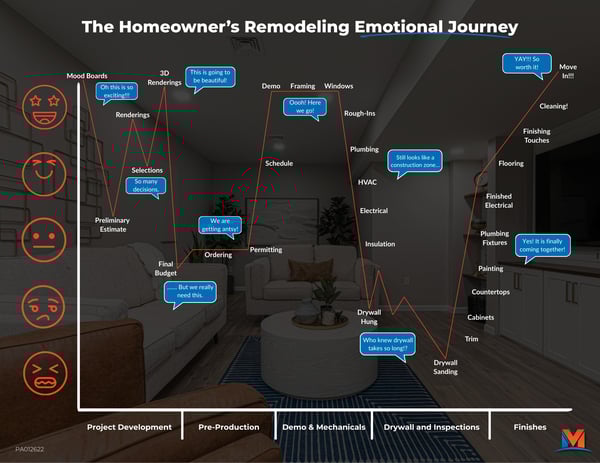
Over the years, we’ve seen that while every remodel is unique, the emotional journey tends to follow a similar arc. We’ve mapped that arc in the graphic below—not to oversimplify the process, but to help homeowners recognize what they’re feeling when they’re in the middle of it.

1. Project Development & Design: When Your Remodeling Vision Takes Shape
"This is going to be beautiful.”
This phase is filled with possibility. You’re seeing renderings, exploring options, and beginning to envision your finished space. There’s excitement…and a surprising number of decisions.
At the same time, this is when the vision becomes grounded in reality. Budgets and specifications are defined, sometimes requiring tradeoffs to align your design priorities with your desired investment.
It’s normal to feel both energized and stretched during this phase as ideas turn into decisions.
2. Pre-Production: When Progress Feels Quiet
“We’re getting antsy…”
This phase often feels slower from the outside. While our team is busy placing orders, securing permits, confirming schedules, and completing internal handoffs in preparation for your project, you’re waiting for construction to begin.
It’s normal to feel eager, restless, or ready for the next step. But this waiting isn’t wasted time. It’s what allows your project to run smoothly once site work begins.
3. Demolition & Framing: When the Remodel Finally Begins
“Oooh! Here we go!”
As demolition starts, all that anticipation turns into excitement. There’s visible movement that’s easy to recognize day by day. The project finally feels real, and there’s momentum you can see with your own eyes.
After weeks of planning and dreaming, it’s a relief to see tangible results.
4. Mechanicals & Drywall: The Most Emotionally Challenging Part of a Remodel
“Still looks the same as yesterday…”
This is often the hardest emotional stretch. Mechanical rough-ins (HVAC, plumbing, electric) are visually subtle compared to demolition and framing. Progress is harder to see from one day to the next.
Drywall is similar. After the initial install, the process of finishing drywall correctly can feel slow and monotonous.
Meanwhile, the novelty of temporary living arrangements wears off. Daily routines feel disrupted. The finish line can feel far away.
If you hit an emotional low here, you’re right on schedule.
5. Finishes & Details: When Remodeling Progress Becomes Visible Again
“Yes! It’s really coming together!”
Hang in there, because once you’ve made it through drywall, progress suddenly becomes obvious again.
Cabinets, flooring, trim, paint…each new finish detail brings your space a step closer to matching those beautiful renderings you fell in love with during design.
Along with visual progress, excitement and enthusiasm return. You’re down to days, not weeks, before the project is completed.
6. Move-In & Completion: Reaching the End of Your Remodeling Journey
“YAY!!! So worth it!”
There’s a moment near the end of a remodel that’s easy to overlook.
Our crew has packed up, cleaned the space, and handed it back to you. Now the house is still and quiet. It’s just you and your remodeled home, ready to get to know one another.
This is when the project stops being about decisions and schedules and checklists, and becomes about you experiencing your home—your sanctuary—in a new and deeper way.
What comes next isn’t about construction. It’s about returning to everyday moments. Forming new routines. Seeing new memories take shape in a home that’s ready to host them.
Congratulations—you’ve survived the emotional journey of remodeling, and it was worth every moment.
Why Expectations Shape the Remodeling Experience
These highs and lows of remodeling aren’t random. You may have noticed a pattern—the difficult emotions tend to show up at predictable points in the process, especially during phases where progress isn’t easily visible.
Understanding that pattern doesn’t mean you won’t experience it, but it can help turn a roller coaster into a rocking chair. The swings in emotion are still there, but they’re gentler and less disruptive because you know what to expect.
In other words, expectations shape experience.
And that’s why thoughtful planning is so important for your remodel.
How Planning and Support Change the Emotional Experience of Remodeling
Planning doesn’t remove the emotional ups and downs of a remodel, but it does change how you experience them.
How? By systematically setting expectations before the project even begins.
When decisions are made early, during Project Development, fewer things feel unexpected during Production. You’re not constantly reacting or making decisions under pressure.
Planning can’t eliminate every surprise, of course. There will always be the potential for unknowns behind the walls—that’s part of working with existing homes—but when you know in advance how those situations will be handled, they tend to feel manageable rather than alarming.
Planning also sets us up as a team to be able to support you well during your remodel.
Support is all about making sure you know what’s happening, what’s next, and who to talk to when questions come up. It’s about steady communication, even during the long middle when progress can feel hard to see.
How You Can Prepare Emotionally for a Home Remodel
A little preparation goes a long way. Before your project begins, it helps to be honest with yourself about what’s ahead.
- Expect moments of fatigue, and give yourself permission to feel them.
- Keep your “why” visible. When decisions feel heavy, clarity about what matters most reduces decision fatigue.
- Accept that not every decision will feel equally satisfying. Some choices are simply functional, and that’s okay. Not every moment in a remodel needs to feel inspiring.
- Think through daily routines ahead of time: cooking, working, resting, and family rhythms. How will these be affected during your remodel?
- Identify your personal stress triggers—noise, dust, lack of privacy—and plan around them where possible.
- Talk to members of your household about what to expect, and agree in advance how to handle changes to your routines.
- Remember that time feels different during construction. Weeks can feel long in the middle of a project and surprisingly short at the beginning and end. That distortion is normal.
A Journey Worth Taking
Remodeling asks a lot of you. Time, energy, patience, and trust.
Understanding the emotional journey helps you recognize when a moment is simply part of the process, not a sign that something has gone wrong.
When you pair that understanding with clear expectations, thoughtful planning, and the right support, remodeling becomes less about enduring disruption and more about moving with intention toward something better.
If you’re considering a remodel and want a team that understands both the practical and emotional sides of the process, we’d be glad to talk with you. Even an early conversation can help bring clarity and perspective.
.png?width=400&height=600&name=Pinterest%20Blog%20(14).png)
Written by Alison McLennan
Alison McLennan is President of McLennan Contracting. She and her husband, Tim, co-own the business and are passionate about creating a company culture that is characterized by collaboration, diligence, and continual learning. When Alison isn't envisioning new horizons for McLennan Contracting, she can be found reading a mystery novel, spoiling her dogs, or planning the family's latest cross-country RV trip.